idempo
Idempo is a framework-agnostic HTTP middleware for Go that implements the IETF Idempotency-Key draft with Stripe-compatible semantics. It makes unsafe requests (payments, order creation, any mutation) safe to retry: a duplicate request runs its side effect at most once and replays the original response.
It is built on Go's standard net/http and works with chi, gin, echo, or
the standard library mux.
The "at most once" guarantee
A client sends a unique Idempotency-Key header with a request. The middleware
records the first response produced for that key and replays it for any later
request that reuses the key, so a retried request runs its side effect at most
once.
Exactly-once execution under concurrent duplicates is enforced by the storage
backend (a mutex in memory, an atomic Lua script in Redis, an
INSERT ... ON CONFLICT in Postgres) and verified by tests that fire 50
simultaneous identical requests and assert the handler ran once. The whole suite
runs under the race detector in CI.
How it works
When a request carries an Idempotency-Key header, the middleware runs the
following lifecycle:
- Claim the key atomically before the handler runs.
- If the key is new, it runs your handler, then stores the response.
- If the same key arrives again with the same request, it replays the
stored response (adding
Idempotency-Replayed: true) without running the handler again. - If the key is still in flight, it returns
409 Conflict. - If the key is reused with a different request (method, path, or body), it
returns
422 Unprocessable Entity.
A request with no Idempotency-Key header passes straight through to your
handler untouched.
Request lifecycle
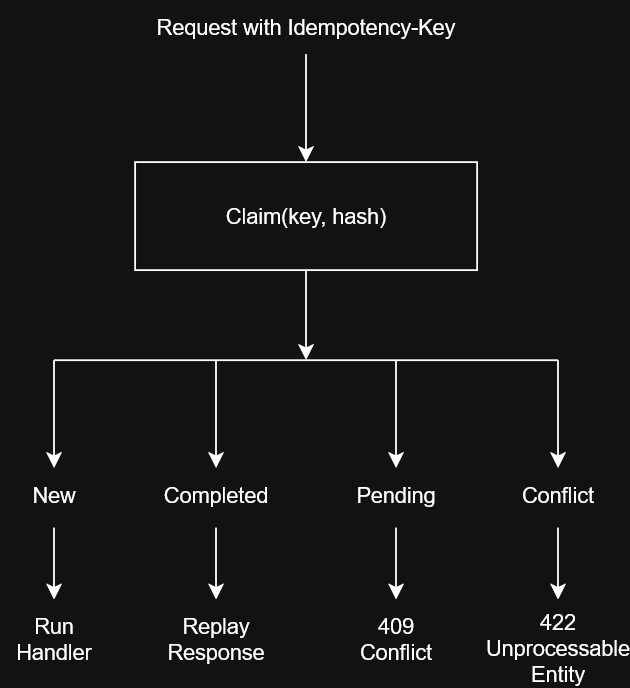
- new → run the handler, then store the response (
Complete) or release the claim (Abandon). - completed → replay the stored response with
Idempotency-Replayed: true. - pending →
409 Conflict. - conflict →
422 Unprocessable Entity.
The two terminal outcomes for a winning claim:
- Complete — the handler finished with a cacheable response (status
< 500, not hijacked, not oversized). The response is stored and retained for the retention TTL so it can be replayed. - Abandon — the handler panicked, returned
5xx, hijacked the connection, or produced an oversized response. The claim is released so the key can be retried.
Install
Continue to Getting started for the quick-start example, or
jump to the Error reference for the application/problem+json
responses the middleware emits.
License
MIT.